Welcome to the Mathematical World!
Wang Zhenyi
Female Pioneer of Mathematics and Astronomy in Qing China
Wang Zhenyi (1768–1797) was an extraordinary mathematician, astronomer, and poet of the Qing dynasty, renowned for breaking gender barriers in the male-dominated intellectual world of 18th-century China. Despite social restrictions, she mastered advanced subjects such as algebra, geometry, and astronomy, becoming a role model for future generations.
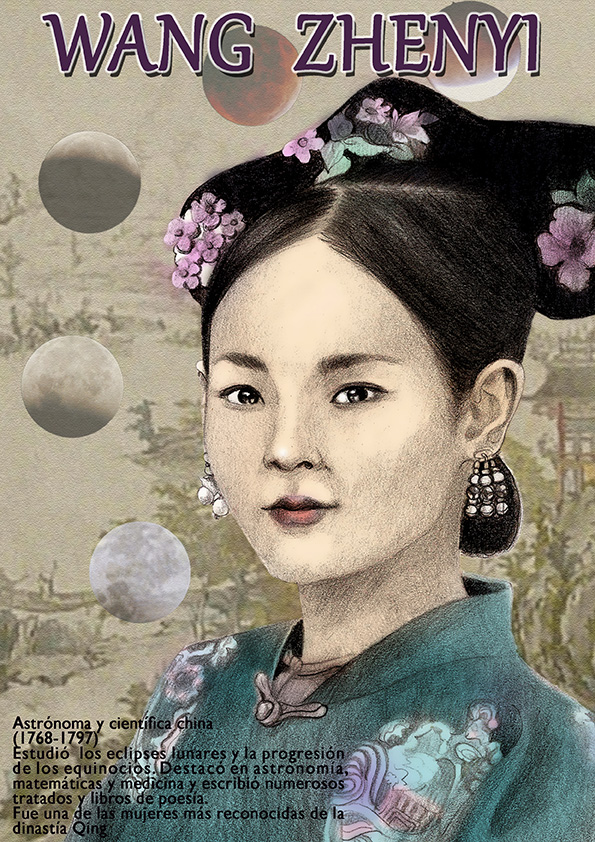
In mathematics, Wang focused on simplifying complex problems so that students could understand them more clearly. She studied Euclidean geometry and Chinese algebra, writing explanatory essays and designing simple teaching aids. One of her notable works was an essay on the binomial theorem, where she explained the expansion of powers such as: \[ (a + b)^2 = a^2 + 2ab + b^2 \] She extended this logic to higher powers, demonstrating remarkable mathematical clarity.
Her interests extended to astronomy. She carefully observed lunar eclipses and explained them scientifically by modeling the Sun, Earth, and Moon with a lamp and mirrors. In doing so, she debunked superstitions that linked eclipses to heavenly omens, emphasizing natural laws instead.
As a poet, she celebrated intellectual freedom and criticized gender inequality, expressing that women were equally capable of learning and reasoning. Though she died at the young age of 29, Wang Zhenyi left behind a legacy of courage, intellect, and pioneering scholarship, making her one of the most remarkable women in the history of science.

All rights reserved by the Mathematical Unity
Contact: +8801400044645
Email: mathematicalhorse1453@gmail.com
Our Discord Server: Mathematical Unity [Ulus Riyadiyat]